
Sheboygan, WI · Garage Door Service
Garage Door Repair in Sheboygan, WI
Torsion spring and opener repair for Sheboygan homes built 1948-1992, where original hardware meets Lake Michigan cold. Same lineup, real parts on the truck.
- Repairs & new doors
- Springs & openers
- Serving 7 nearby communities
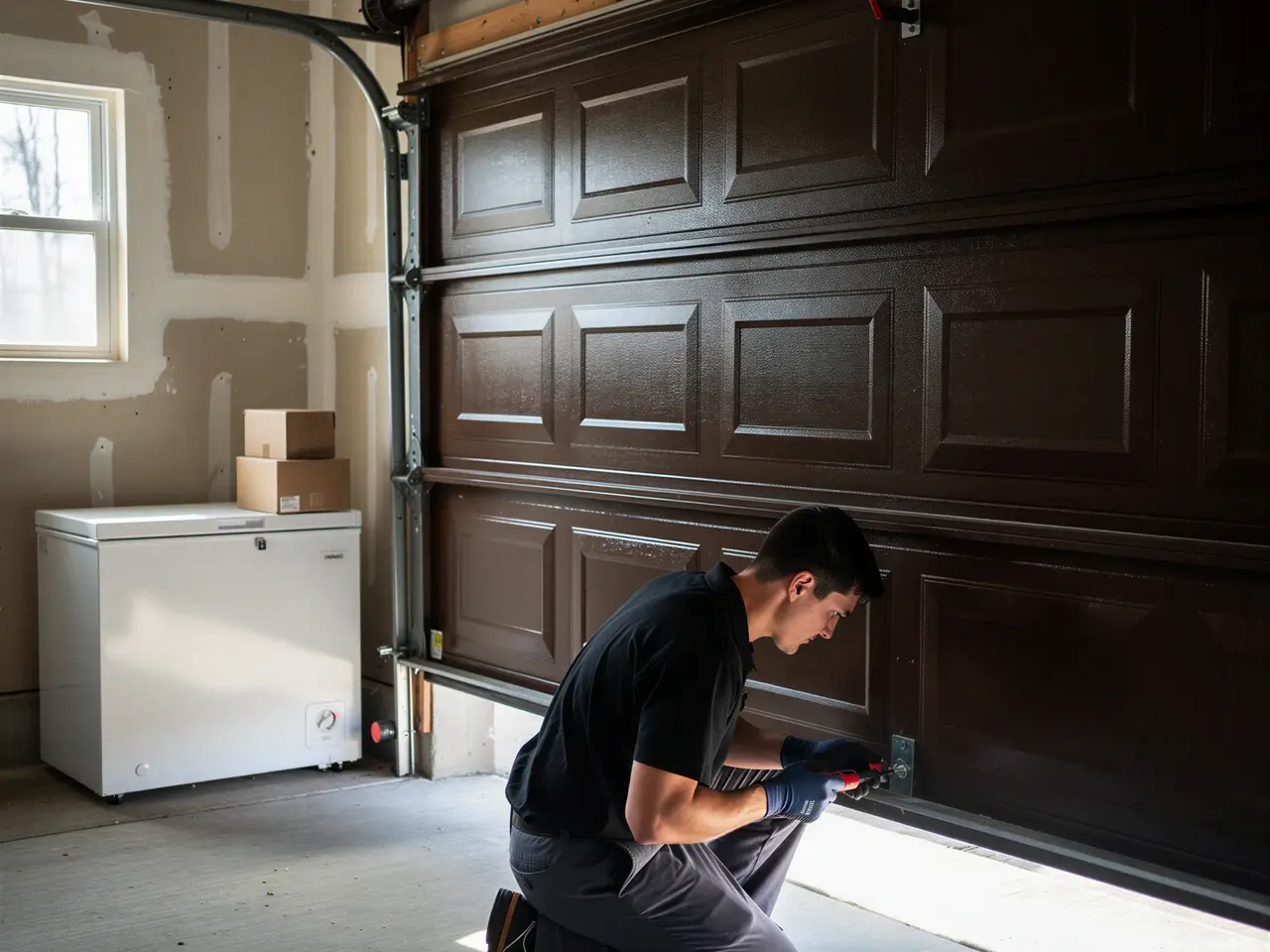
What You Are Seeing
A door that won't budge, or one that lurches up a few inches and stops. A loud bang from the garage followed by a door that goes dead-weight heavy - that's almost always a torsion spring letting go. Sometimes it's quieter: the opener hums, the gears strip, and the door just sits there while the motor whines.
In Sheboygan, we see this pattern constantly because of what's actually in the walls. Most of the service area's housing went up between 1948 and 1992, with the bulk of it dating to the 1960s and 70s across the 17 named communities we cover - Kohler, Sheboygan Falls, Wilson, Howards Grove, and the rest. That means a lot of original torsion hardware, often on side-mount setups that newer doors don't use anymore, and a lot of springs that have outlived their rated cycle count by a decade or more.
If your door is slow to respond to the remote, shudders partway up, or the cables look frayed near the bottom bracket, you're looking at wear that's been building since the house was built - not a sudden defect.
Why This Fails Locally
Two things stack on top of each other here: the age of the housing and the cold. Sheboygan sits in a severe cold climate band, and steel torsion springs lose temper faster when they're cycling through hard freezes every winter. A spring rated for a certain number of cycles in a mild climate gets fewer usable cycles here - the metal fatigues quicker with repeated contraction in sub-zero mornings.
Pair that with housing stock built mostly in the 1960s and 70s, and you've got springs, cables, and rollers that were installed when Eisenhower-era or Nixon-era torsion standards were normal, not today's. A lot of these doors were never upgraded past their original hardware because the door itself still looks fine - the opener runs, the panels aren't dented, so nobody thinks about the spring until it snaps.
The other local factor is simple math: with 13,133 owner-occupied houses across the area and a median household income of $86,023, most homeowners here own rather than rent, and they tend to fix a door rather than replace the whole unit when a spring goes - which is usually the right call, but only if the replacement spring matches the door's actual weight and wind load, not a generic size off a shelf.
How We Fix It
We start by weighing the door, not guessing at it. A torsion spring sized wrong for the door's actual weight will either strain the opener or snap again within a year - we've seen plenty of mismatched springs from past repairs on older Sheboygan doors, where someone grabbed whatever size was on hand.
For a snapped spring, we pull both springs as a pair even if only one failed, because the other one is the same age and has taken the same cold-cycle fatigue. We check the cable condition, the bottom brackets, and the drum alignment at the same time, since a spring failure often stresses those parts too.
For opener trouble - stripped gears, a dead capacitor, a motor that runs but doesn't lift - we test the logic board and the drive mechanism separately before replacing anything. Sometimes it's a $20 capacitor, not a $300 motor.
One honest limit: if the door itself is original from the 1960s or 70s and the track is bent or the panels are rusted through, we'll tell you straight that a spring fix is a band-aid. At that point replacement is the better use of your money, and we'll say so instead of patching it twice.
What Is on the Truck
We carry torsion springs in a range of wire sizes and wind lengths to match older side-mount setups as well as newer center-mount torsion systems, because both show up across the area - from Kohler out through Howards Grove and Oostburg. We stock standard cable sizes, rollers, and bottom brackets for the common door weights we see on 1960s and 70s construction.
For openers, we carry logic boards and capacitors for the drive types most common in this housing era, plus a basic stock of remotes and wall controls. What we don't carry is every spring size for every custom door - some architectural doors built outside the standard ranges need a special-order spring, and we'll tell you upfront if that's your situation rather than forcing a wrong-size fit onto the truck's shelf stock.
Full panel replacements and track sections ride along for jobs where cold-weather metal fatigue has taken out more than the spring - a cracked bottom panel from a winter impact, for instance. We load based on what actually fails on doors this age, not a generic parts list.
Frequently asked questions
Why did my garage door spring break in the middle of winter?
Cold makes steel more brittle and springs cycle through more stress in freezing temperatures. Combined with age - a lot of Sheboygan doors run original torsion springs from a 1960s or 70s build - winter is when a spring that's been weakening for years finally lets go. It's rarely a coincidence tied to one cold snap; the fatigue was already there.
Do you replace one spring or both when one breaks?
We replace both on a two-spring door, even if just one snapped. They're almost always the same age and have taken identical wear, so the second one is close behind. Replacing only the broken one means a mismatched pair and a service call again soon - we'd rather do the job once.
Is my door too old to repair instead of replace?
Depends on the door, not just the age. If the panels and track are solid and it's a spring or opener issue, repair makes sense. If the track is bent or panels are rusted through on an original 1960s-70s door, we'll tell you replacement is the better value rather than patching it twice.
How do I know if it's the spring or the opener?
If the door is heavy to lift by hand with the opener disconnected, it's the spring. If the door moves freely by hand but the opener won't lift it or stalls partway, the problem's in the motor, gears, or logic board. We test both separately on the call.
Related services
Related guides
By Neighborhood
Garage Door Repair across the Sheboygan area
We also handle garage door repair in these Sheboygan-area suburbs.
Book garage door service in Sheboygan
Call now or request a quote - tell us what the door is doing and where you are.